
Accessible leakage review
Air Duct Sealing and Leakage Control in South Florida
Steamly Pro reviews accessible duct connections, register boots, exterior seams and visible leakage concerns before recommending a next step. Sealing is planned only when the material, access, moisture condition and documented service scope allow it; mechanical HVAC work and regulated repairs are directed to an appropriately licensed contractor.
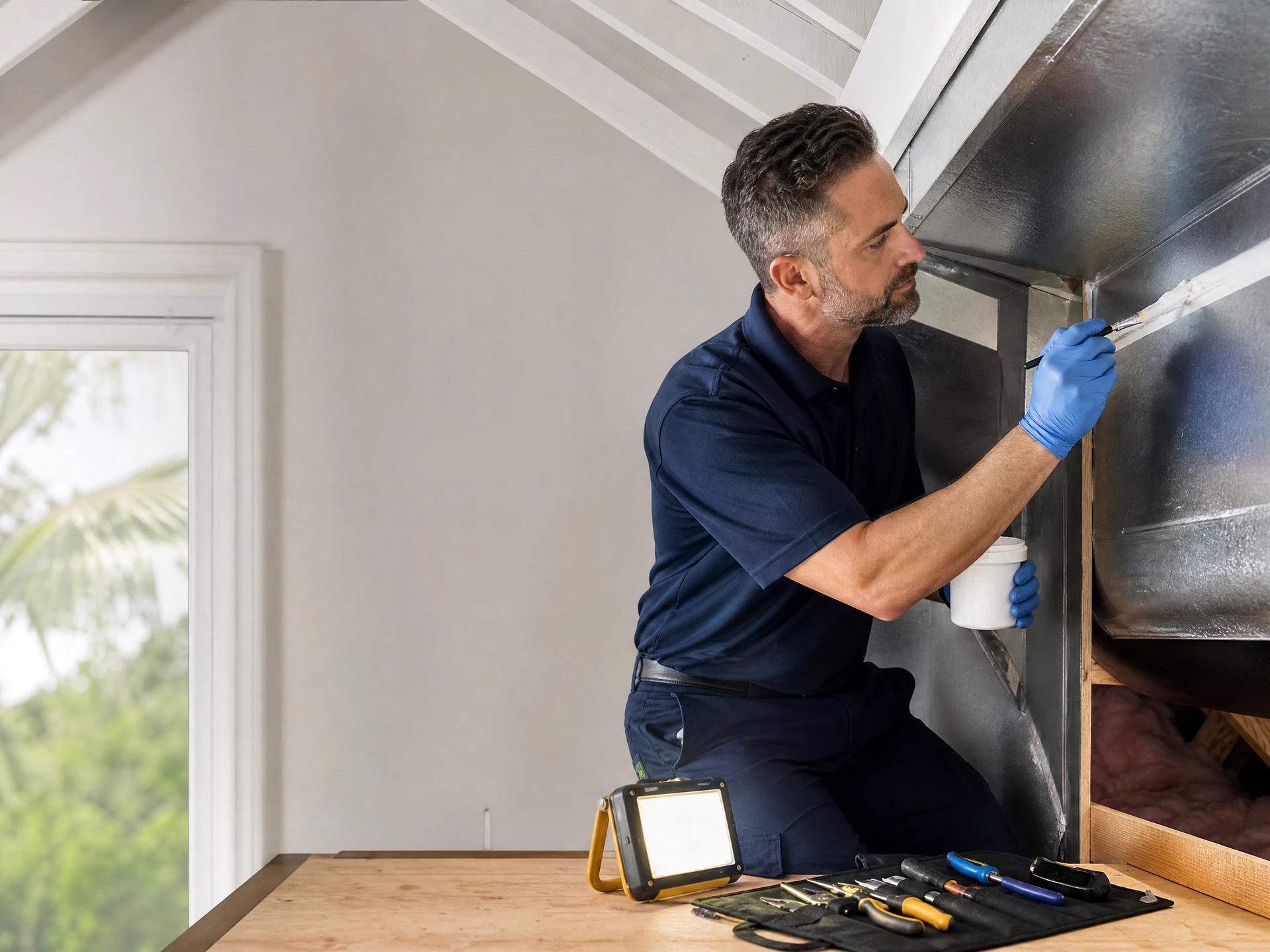 Illustrative previewTemporary review media
Layout preview — not job proof
Accessible duct-joint sealing layout preview
Temporary illustrative media for layout review. Replace it with an original Steamly Pro duct-sealing photo before presenting this space as real-work proof.
This temporary image illustrates the intended visual layout for Air Duct Sealing & Leakage Control and is not evidence of a completed Steamly Pro project.
What we address
A thoughtful approach to air duct sealing & leakage control.
The exact method depends on material, construction, condition and access. These are the common concerns and surfaces reviewed during an estimate.
Common concerns
- Visible gaps at accessible duct connections
- Loose or poorly sealed register boots
- Air movement at accessible exterior seams
- Dust or moisture entry near visible leakage points
- Questions after duct cleaning or renovation
Items and surfaces
- Accessible metal duct joints
- Accessible exterior duct seams
- Register and grille connections
- Visible boots and plenums after scope review
- Residential and light-commercial systems that can be evaluated safely
Our process
Clear steps, adjusted to the job.
The technician confirms the surface and scope before treatment. If the inspection changes the safe plan, that is discussed first.
- 1Review system type, access and the reported concern
- 2Document visible accessible leakage and damaged sections
- 3Check for moisture, suspected microbial growth and mechanical issues that require referral
- 4Confirm whether sealing work fits the documented service and licensing scope
- 5Use material-compatible methods and follow manufacturer directions when work is approved
- 6Review completed accessible areas and explain unresolved or inaccessible conditions
Honest limitation
Duct sealing is not mold remediation, air-duct cleaning or a guaranteed indoor-air-quality, comfort, energy or health outcome. Active moisture, suspected mold, damaged flex duct, concealed leakage, system alterations and code-controlled repair may require licensed HVAC, mold-assessment or remediation professionals before sealing.
Benefits
What professional service is designed to improve.
Questions
Air Duct Sealing & Leakage Control FAQs
Get clear answers, then send photos or details when the situation needs a condition-specific review.
Related services
Complete the right cleaning plan.
Air Duct Cleaning
Air-duct projects begin with system access, layout and condition—not a one-size-fits-all promise. We review accessible components and explain what can be cleaned safely before work begins.
Explore serviceWater Extraction & Drying
When unwanted water is present, the immediate priorities are safety, stopping the source when possible and removing standing water. Steamly Pro can evaluate eligible extraction and drying work and explain when a licensed restoration specialist is required.
Explore serviceWhole-House Sanitizing
Whole-house sanitizing begins with cleaning visible soil and identifying compatible, reachable surfaces. Steamly Pro reviews the property, occupants, pets, ventilation, sensitivities and product-label directions before defining which areas can be sanitized safely and what must be excluded.
Explore service